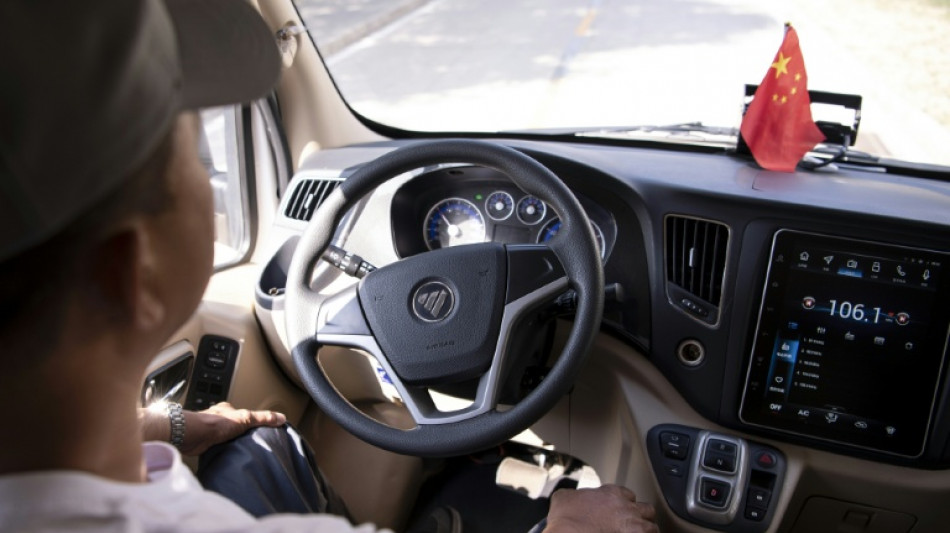
China top court says drivers responsible despite autonomous technology / Photo: NOEL CELIS - AFP/File

 London
 16 °C
16 °C
 Manchester
 9 °C
9 °C
 Glasgow
12 °C
Glasgow
12 °C
 Dublin
 11 °C
11 °C
 Belfast
 13 °C
13 °C
 Washington
18 °C
Washington
18 °C
 Denver
 28 °C
28 °C
 Atlanta
30 °C
Atlanta
30 °C
 Dallas
 23 °C
23 °C
 Houston Texas
31 °C
Houston Texas
31 °C
 New Orleans
26 °C
New Orleans
26 °C
 El Paso
 22 °C
22 °C
 Phoenix
34 °C
Phoenix
34 °C
 Los Angeles
38 °C
San Diego
38 °C
San Francisco
28 °C
Chicago
20 °C
Minneapolis
21 °C
Seattle
20 °C
Portland
23 °C
Salt Lake City
27 °C
Las Vegas
33 °C
Miami
30 °C
Jacksonville
32 °C
San Antonio
26 °C
Bermuda
Los Angeles
38 °C
San Diego
38 °C
San Francisco
28 °C
Chicago
20 °C
Minneapolis
21 °C
Seattle
20 °C
Portland
23 °C
Salt Lake City
27 °C
Las Vegas
33 °C
Miami
30 °C
Jacksonville
32 °C
San Antonio
26 °C
Bermuda
 28 °C
Nassau
21 °C
Iqaluit
2 °C
Yellowknife
6 °C
Anchorage
1 °C
Fairbanks
-1 °C
Barrow
-5 °C
Calgary
15 °C
Edmonton
23 °C
Winnipeg
16 °C
Goose Bay
15 °C
Halifax
18 °C
Boston
19 °C
Ottawa
16 °C
Toronto
16 °C
Detroit
18 °C
Cleveland
18 °C
New York
22 °C
Baltimore
19 °C
Philadelphia
22 °C
Nuuk (Godthåb)
4 °C
Hong Kong
27 °C
Singapore
27 °C
Melbourne
28 °C
Canberra
7 °C
Adelaide
13 °C
Darwin
25 °C
Perth
13 °C
Fort Worth
22 °C
Honolulu
28 °C
Sydney
13 °C
Johannesburg
12 °C
Dubai
33 °C
Mumbai
30 °C
Zürich
17 °C
Tokyo
18 °C
Seoul
13 °C
Delhi
27 °C
Beijing
12 °C
Riyadh
32 °C
Prague
14 °C
Pennsylvania
22 °C
Valletta
20 °C
Manama
33 °C
Warsaw
13 °C
Stockholm
14 °C
28 °C
Nassau
21 °C
Iqaluit
2 °C
Yellowknife
6 °C
Anchorage
1 °C
Fairbanks
-1 °C
Barrow
-5 °C
Calgary
15 °C
Edmonton
23 °C
Winnipeg
16 °C
Goose Bay
15 °C
Halifax
18 °C
Boston
19 °C
Ottawa
16 °C
Toronto
16 °C
Detroit
18 °C
Cleveland
18 °C
New York
22 °C
Baltimore
19 °C
Philadelphia
22 °C
Nuuk (Godthåb)
4 °C
Hong Kong
27 °C
Singapore
27 °C
Melbourne
28 °C
Canberra
7 °C
Adelaide
13 °C
Darwin
25 °C
Perth
13 °C
Fort Worth
22 °C
Honolulu
28 °C
Sydney
13 °C
Johannesburg
12 °C
Dubai
33 °C
Mumbai
30 °C
Zürich
17 °C
Tokyo
18 °C
Seoul
13 °C
Delhi
27 °C
Beijing
12 °C
Riyadh
32 °C
Prague
14 °C
Pennsylvania
22 °C
Valletta
20 °C
Manama
33 °C
Warsaw
13 °C
Stockholm
14 °C
China's top court has issued a ruling confirming humans in cars with assisted driving technology are responsible for their vehicle, setting a nationwide benchmark as Beijing positions itself as a standards-setter in the auto market.
In its ruling the court referred to a case in which a man relied on the technology while drunk and asleep at the wheel.
Chinese tech companies and carmakers have poured billions of dollars into autonomous driving technology in the race to outperform each other, as well as rivals in the United States and Europe.
However, Beijing has moved to tighten safety rules after a high-profile crash last March.
Drivers are still responsible for ensuring road safety after activating assisted driving functions, China's top court said in a "guiding case" issued on Friday.
The reference case is a September ruling in southern Zhejiang province, in which a driver surnamed Wang was jailed and fined for fully relying on the assisted driving system while drunk.
Wang installed a device to mimic hand grip on the steering wheel, set the car to drive then fell asleep in the passenger seat, the court said.
Police found Wang after the car stopped in the middle of a road.
"The on-board assisted driving system cannot replace the driver as the primary driving subject," the Supreme People's Court said in the Friday ruling.
The driver "is still the one who actually performs the driving tasks and bears the responsibility to ensure driving safety", it added.
While most such systems currently used on the road specify that the driver is ultimately in control of the car, the court's ruling now makes that a legal standard nationwide.
Lower courts are to reference the judgement when deciding on similar cases.
Beijing had already warned leading automakers that safety rules would be more tightly enforced after a crash that killed three college students last March raised concerns over the advertising of cars as being capable of autonomous driving.
Friday's guidance comes after China announced it will ban hidden door handles on cars, a minimalist design popularised by Tesla, from next year -- also over safety concerns.
Folding into the body of the car, such door handles help reduce drag while in motion but are prone to losing operability in the event of a crash.
One high-profile incident occurred in October, when rescuers were shown failing to open the doors of a burning electric vehicle in the southwestern city of Chengdu.
E.Roger--PS