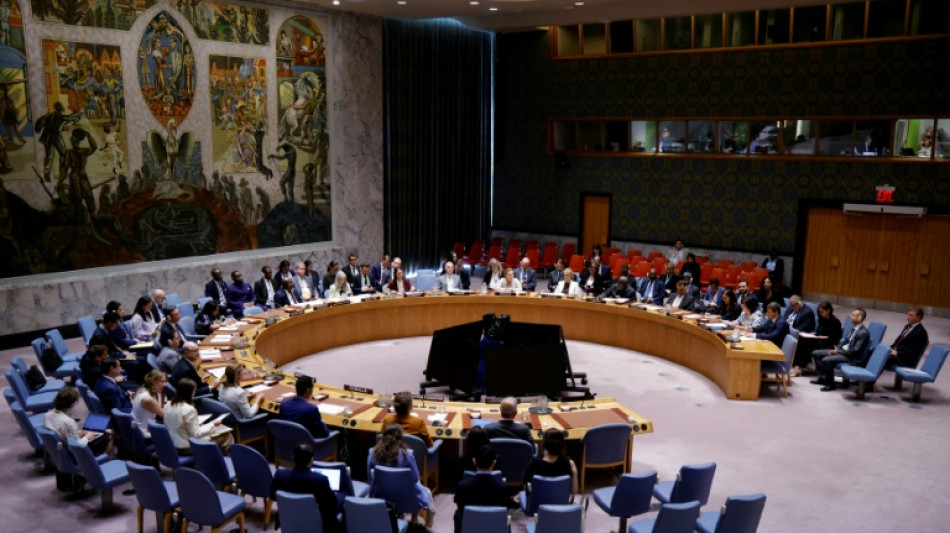
Mideast turmoil, AI set to dominate UN gathering of world leaders / Photo: Leonardo MUNOZ - AFP/File

 London
 12 °C
12 °C
 Manchester
 13 °C
13 °C
 Glasgow
13 °C
Glasgow
13 °C
 Dublin
13 °C
Dublin
13 °C
 Belfast
13 °C
Belfast
13 °C
 Washington
24 °C
Washington
24 °C
 Denver
21 °C
Denver
21 °C
 Atlanta
25 °C
Atlanta
25 °C
 Dallas
 32 °C
32 °C
 Houston Texas
28 °C
Houston Texas
28 °C
 New Orleans
27 °C
New Orleans
27 °C
 El Paso
 27 °C
27 °C
 Phoenix
30 °C
Phoenix
30 °C
 Los Angeles
21 °C
San Diego
21 °C
San Francisco
17 °C
Chicago
20 °C
Minneapolis
16 °C
Seattle
18 °C
Portland
23 °C
Salt Lake City
25 °C
Las Vegas
31 °C
Miami
27 °C
Jacksonville
26 °C
San Antonio
29 °C
Bermuda
26 °C
Nassau
23 °C
Iqaluit
0 °C
Yellowknife
9 °C
Anchorage
13 °C
Fairbanks
10 °C
Barrow
1 °C
Calgary
13 °C
Edmonton
26 °C
Winnipeg
10 °C
Goose Bay
16 °C
Halifax
21 °C
Boston
21 °C
Ottawa
16 °C
Toronto
17 °C
Detroit
19 °C
Cleveland
22 °C
New York
25 °C
Baltimore
24 °C
Philadelphia
24 °C
Nuuk (Godthåb)
Los Angeles
21 °C
San Diego
21 °C
San Francisco
17 °C
Chicago
20 °C
Minneapolis
16 °C
Seattle
18 °C
Portland
23 °C
Salt Lake City
25 °C
Las Vegas
31 °C
Miami
27 °C
Jacksonville
26 °C
San Antonio
29 °C
Bermuda
26 °C
Nassau
23 °C
Iqaluit
0 °C
Yellowknife
9 °C
Anchorage
13 °C
Fairbanks
10 °C
Barrow
1 °C
Calgary
13 °C
Edmonton
26 °C
Winnipeg
10 °C
Goose Bay
16 °C
Halifax
21 °C
Boston
21 °C
Ottawa
16 °C
Toronto
17 °C
Detroit
19 °C
Cleveland
22 °C
New York
25 °C
Baltimore
24 °C
Philadelphia
24 °C
Nuuk (Godthåb)
 3 °C
Hong Kong
31 °C
Singapore
3 °C
Hong Kong
31 °C
Singapore
 31 °C
Melbourne
27 °C
Canberra
31 °C
Melbourne
27 °C
Canberra
 20 °C
Adelaide
21 °C
Darwin
32 °C
Perth
25 °C
Fort Worth
31 °C
Honolulu
27 °C
Sydney
25 °C
Johannesburg
11 °C
Dubai
31 °C
Mumbai
28 °C
Zürich
13 °C
Tokyo
24 °C
Seoul
20 °C
Adelaide
21 °C
Darwin
32 °C
Perth
25 °C
Fort Worth
31 °C
Honolulu
27 °C
Sydney
25 °C
Johannesburg
11 °C
Dubai
31 °C
Mumbai
28 °C
Zürich
13 °C
Tokyo
24 °C
Seoul
 28 °C
Delhi
28 °C
Beijing
26 °C
Riyadh
27 °C
Prague
12 °C
Pennsylvania
22 °C
Valletta
26 °C
Manama
33 °C
Warsaw
12 °C
Stockholm
13 °C
28 °C
Delhi
28 °C
Beijing
26 °C
Riyadh
27 °C
Prague
12 °C
Pennsylvania
22 °C
Valletta
26 °C
Manama
33 °C
Warsaw
12 °C
Stockholm
13 °C
As wars rage in the Middle East, Ukraine and Sudan, and fears mount over rapidly advancing AI, world leaders descend on the UN in New York from Tuesday for the world's signature diplomatic event.
US President Donald Trump's war against Iran and its worldwide fallout are expected to dominate this year's United Nations General Assembly High-level Week.
Ukrainian President Volodymyr Zelensky will meanwhile urge allies not to lose focus on his country's defense needs, as Russia retaliates for long-range drone strikes against its energy infrastructure.
"When we see the Russia-Ukraine war, and when we see the whole Middle East, every day things get a little bit worse," said UN Secretary-General Antonio Guterres ahead of the gathering.
"There is no improvement anywhere, and when things evolve in a way that every day things get a little bit worse, we are at a serious risk of an explosion."
Artificial intelligence will also be a key topic in talks and speeches, with its potential threats to humanity dominating global headlines after tech leaders sounded the alarm.
An emergency Security Council meeting is set to be held on the issue.
"This year's UNGA could be where a plan starts to take shape to define what the world wants from industry's pledge on safety and who is responsible for monitoring it," said Nicolas Miailhe, an AI governance expert and co-founder of AI Safety Connect.
"The harder part will be agreeing on what that plan looks like and moving it into reality."
Amid fierce competition between the United States and China on AI, Guterres urged more global coordination.
"The world cannot afford a race to the bottom on AI safety," he said.
Behind the scenes, the world's power brokers will also be wrangling over the UN's future, seeking to thrash out a deal on a candidate to lead the organization riven with divisions and budget black holes.
No breakthrough is expected, but the global powers wielding vetoes over the process -- Britain, France, Russia, China and the United States -- could well use the gathering to seal a deal.
Guterres's second five-year term ends on December 31, 2026 after a tenure marked by surging global conflict, the coronavirus pandemic, mounting inequality and rampant polarization.
One European diplomat said the selection process was "not very successful so far... any kind of consensus is not emerging."
- 'Existential threats' -
The Israeli-Palestinian conflict -- from a sputtering Gaza peace process to Israel's expansion of settlements in the occupied West Bank -- will once again be among the divisive issues facing world leaders.
Israeli Prime Minister Benjamin Netanyahu is expected to attend for a lightning visit, after New York Mayor Zohran Mamdani admitted he was unable to execute an International Criminal Court (ICC) arrest warrant against him.
The Trump administration has denied US visas to Mahmoud Abbas and other Palestinian leaders for a second year.
China's President Xi Jinping will skip the diplomatic gathering and instead go straight to Washington for a state visit with Trump.
Beijing's support for Russia and Iran will be among the thorny subjects under discussion.
"China has long seen high-level week as US turf," said the International Crisis Group's Daniel Forti.
"And while the Chinese diplomats at the UN are really intentionally trying to position themselves as a more predictable and stable big power compared to Washington, our assessment is that Xi doesn't need the spotlight at high-level week to make that case," he added.
With heat records being broken around the globe and extreme weather events multiplying, Guterres, as he has throughout his tenure, will continue to push for more global action against climate change.
He will convene a meeting on Climate Action and the Just Transition, followed by a day dedicated to sea-level rise, an existential threat for low-lying island nations.
The climate and environmental harms associated with artificial intelligence -- as well as its potentially catalytic benefits -- are expected to figure heavily at the UN and the broader Climate Week around it in New York, an annual jamboree of activists, corporations and academics.
K.Grimaud--PS