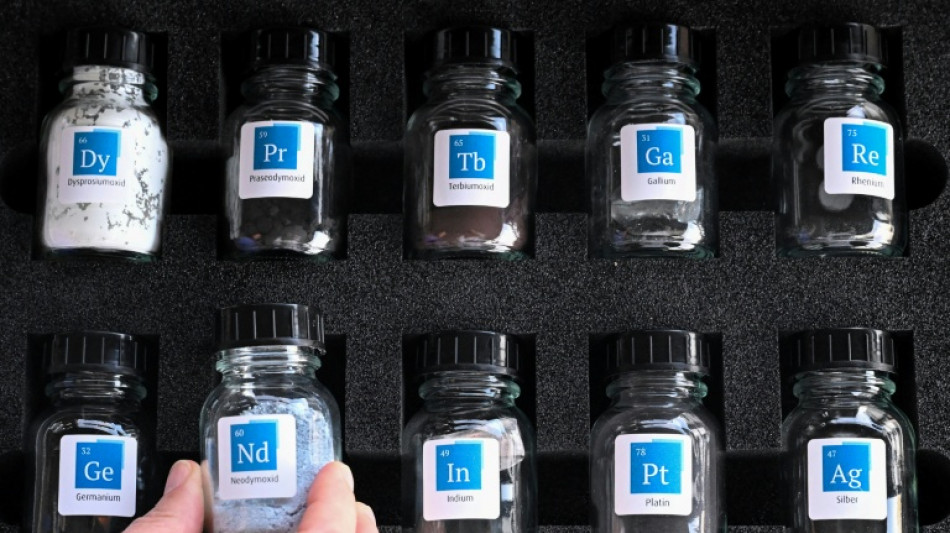
US races to secure rare earths to rebuild depleted arsenal / Photo: Kirill KUDRYAVTSEV - AFP/File

 London
 8 °C
8 °C

 Manchester
5 °C
Manchester
5 °C
 Glasgow
 10 °C
10 °C
 Dublin
 5 °C
5 °C
 Belfast
9 °C
Belfast
9 °C
 Washington
 14 °C
14 °C
 Denver
 6 °C
6 °C
 Atlanta
 11 °C
11 °C
 Dallas
 11 °C
11 °C
 Houston Texas
15 °C
Houston Texas
15 °C
 New Orleans
17 °C
New Orleans
17 °C
 El Paso
9 °C
El Paso
9 °C
 Phoenix
23 °C
Phoenix
23 °C
 Los Angeles
26 °C
San Diego
30 °C
San Francisco
19 °C
Chicago
6 °C
Minneapolis
3 °C
Seattle
16 °C
Portland
13 °C
Salt Lake City
11 °C
Las Vegas
20 °C
Miami
26 °C
Jacksonville
24 °C
San Antonio
13 °C
Bermuda
25 °C
Nassau
12 °C
Iqaluit
-11 °C
Yellowknife
6 °C
Anchorage
5 °C
Fairbanks
0 °C
Barrow
Los Angeles
26 °C
San Diego
30 °C
San Francisco
19 °C
Chicago
6 °C
Minneapolis
3 °C
Seattle
16 °C
Portland
13 °C
Salt Lake City
11 °C
Las Vegas
20 °C
Miami
26 °C
Jacksonville
24 °C
San Antonio
13 °C
Bermuda
25 °C
Nassau
12 °C
Iqaluit
-11 °C
Yellowknife
6 °C
Anchorage
5 °C
Fairbanks
0 °C
Barrow
 -3 °C
Calgary
10 °C
Edmonton
10 °C
Winnipeg
5 °C
Goose Bay
4 °C
Halifax
12 °C
Boston
12 °C
Ottawa
4 °C
Toronto
3 °C
Detroit
6 °C
Cleveland
8 °C
New York
13 °C
Baltimore
15 °C
Philadelphia
12 °C
Nuuk (Godthåb)
1 °C
Hong Kong
30 °C
Singapore
-3 °C
Calgary
10 °C
Edmonton
10 °C
Winnipeg
5 °C
Goose Bay
4 °C
Halifax
12 °C
Boston
12 °C
Ottawa
4 °C
Toronto
3 °C
Detroit
6 °C
Cleveland
8 °C
New York
13 °C
Baltimore
15 °C
Philadelphia
12 °C
Nuuk (Godthåb)
1 °C
Hong Kong
30 °C
Singapore
 33 °C
Melbourne
25 °C
Canberra
16 °C
Adelaide
33 °C
Melbourne
25 °C
Canberra
16 °C
Adelaide
 23 °C
Darwin
33 °C
Perth
23 °C
Fort Worth
10 °C
Honolulu
25 °C
Sydney
18 °C
Johannesburg
25 °C
Dubai
35 °C
Mumbai
33 °C
Zürich
13 °C
Tokyo
24 °C
Seoul
26 °C
Delhi
30 °C
Beijing
17 °C
Riyadh
35 °C
Prague
11 °C
Pennsylvania
13 °C
Valletta
24 °C
Manama
36 °C
Warsaw
8 °C
Stockholm
8 °C
23 °C
Darwin
33 °C
Perth
23 °C
Fort Worth
10 °C
Honolulu
25 °C
Sydney
18 °C
Johannesburg
25 °C
Dubai
35 °C
Mumbai
33 °C
Zürich
13 °C
Tokyo
24 °C
Seoul
26 °C
Delhi
30 °C
Beijing
17 °C
Riyadh
35 °C
Prague
11 °C
Pennsylvania
13 °C
Valletta
24 °C
Manama
36 °C
Warsaw
8 °C
Stockholm
8 °C
The United States is working hard to create a supply chain for rare earths -- metals needed to replenish its military arsenal amid the conflict in Iran -- that does not depend on China, the sector's global leader.
Just a few grams of these materials are needed to make a television or laptop computer, but hundreds of grams are required for each Tomahawk or Patriot missile.
The Payne Institute for Public Policy at the Colorado School of Mines estimates US forces have fired thousands of missiles at Iranian targets since late February.
"The Middle East conflict is exposing in real time which minerals are truly mission-critical and exactly where supply chains could break under pressure," said Mahnaz Khan, a vice president of the Silverado Policy Accelerator think tank.
"This could add another layer of stress to the nation's ability to reconstitute the weapons," Khan said, noting that rare earths are used in "everything from drones and interceptors to F-35s and precision-guided missiles."
The Center for Strategic and International Studies, another think tank in Washington, said in late April that "restoring depleted stockpiles and then achieving the desired inventory levels will take many years."
The most-used rare earths are neodymium and praseodymium. Both are vital in the manufacture of so-called "permanent" magnets, which are 10 times stronger than traditional magnets and used in electric vehicles, wind turbines and smartphones.
Samarium, another of the 17 rare earths, is used in magnets needed in the defense industry.
During Donald Trump's first term as president, and then under his successor Joe Biden, the United States boosted its share of global rare earth production from three to 13 percent, thanks to subsidies and tax incentives.
Until last year, there was only one major rare earths mine -- at Mountain Pass in California, operated by MP Materials.
In July, Ramaco Resources opened the first new rare earths mine in more than 70 years -- the Brook mine in Wyoming, but so far, nothing has been produced at the site.
Other mine projects are in development in Montana, Wyoming and Nebraska.
The United States is also counting on recycling to help fuel its supply chains.
Trump's administration is looking abroad as well. It recently facilitated the acquisition of Brazilian producer Serra Verde by startup USA Rare Earth, in which the US government took a 10 percent stake in January.
- 'Leapfrog' China -
But extraction is only the first phase of a process that also includes refining and separation (in order to isolate the various elements) before processing.
The separation stage is what has helped China dominate the sector. As of last year, it controlled 91 percent of global separation by volume, according to the International Energy Agency.
Authorities in China have used rare earths as a bargaining chip. Last year, Beijing restricted exports of certain rare earths before later lifting the measure.
India, Japan and France are also working hard to unlock China's stranglehold on the industry.
And the subject will be on the agenda for Trump's talks in Beijing with Chinese President Xi Jinping this week.
James Litinsky, the CEO of MP Materials -- in which the government has a 15 percent stake, to launch separation operations -- said separation activities will begin "imminently" at the Mountain Pass site.
In January, US firm Energy Fuels -- which also produces uranium -- took control of Australia's ASM and is planning to build a new site in the United States, which will handle separation.
USA Rare Earth has invested in French rare earths specialist Carester, and they are together working on perfecting the separation process.
As for the end of the supply chain, startups Vulcan Elements and eVAC Magnetics started making permanent magnets last year. MP Materials should join that group shortly.
"We're not just selling magnets," Vulcan Elements CEO John Maslin told AFP.
"We're offering a secure, China-independent supply chain. Our priority is ensuring that the United States and its allies can access the magnets they'll need for national security and economic resilience."
For Roderick Eggert, a professor at the Colorado School of Mines, it will take time for competitors to grow big enough to "significantly reduce the market shares of the Chinese producers."
To hedge its bets, the United States has in recent months reached deals with producer nations including Australia, Democratic Republic of Congo, Rwanda and Thailand.
Maslin said the idea of the United States being completely autonomous in terms of rare earths, from extraction to selling permanent magnets, is not far-fetched.
"The industry has to innovate and leapfrog, and not just copy and paste China," he said.
D.Gautier--PS