Mobile clinics battle Mongolia's childhood dental 'disaster' / Photo: Hector RETAMAL - AFP

 London
 15 °C
15 °C

 Manchester
14 °C
Manchester
14 °C
 Glasgow
8 °C
Glasgow
8 °C
 Dublin
16 °C
Dublin
16 °C
 Belfast
16 °C
Belfast
16 °C
 Washington
24 °C
Washington
24 °C
 Denver
8 °C
Denver
8 °C
 Atlanta
 25 °C
25 °C
 Dallas
28 °C
Dallas
28 °C
 Houston Texas
 27 °C
27 °C
 New Orleans
25 °C
New Orleans
25 °C
 El Paso
24 °C
El Paso
24 °C
 Phoenix
22 °C
Phoenix
22 °C
 Los Angeles
22 °C
San Diego
22 °C
San Francisco
18 °C
Chicago
16 °C
Minneapolis
9 °C
Seattle
15 °C
Portland
19 °C
Salt Lake City
Los Angeles
22 °C
San Diego
22 °C
San Francisco
18 °C
Chicago
16 °C
Minneapolis
9 °C
Seattle
15 °C
Portland
19 °C
Salt Lake City
 10 °C
Las Vegas
21 °C
Miami
28 °C
Jacksonville
22 °C
San Antonio
29 °C
Bermuda
24 °C
Nassau
22 °C
Iqaluit
10 °C
Las Vegas
21 °C
Miami
28 °C
Jacksonville
22 °C
San Antonio
29 °C
Bermuda
24 °C
Nassau
22 °C
Iqaluit
 0 °C
Yellowknife
3 °C
Anchorage
3 °C
Fairbanks
3 °C
Barrow
0 °C
Yellowknife
3 °C
Anchorage
3 °C
Fairbanks
3 °C
Barrow
 -8 °C
Calgary
9 °C
Edmonton
-8 °C
Calgary
9 °C
Edmonton
 25 °C
Winnipeg
7 °C
Goose Bay
11 °C
Halifax
17 °C
Boston
17 °C
Ottawa
10 °C
Toronto
12 °C
Detroit
14 °C
Cleveland
14 °C
New York
23 °C
Baltimore
24 °C
Philadelphia
23 °C
Nuuk (Godthåb)
0 °C
Hong Kong
29 °C
Singapore
25 °C
Melbourne
27 °C
Canberra
17 °C
Adelaide
25 °C
Winnipeg
7 °C
Goose Bay
11 °C
Halifax
17 °C
Boston
17 °C
Ottawa
10 °C
Toronto
12 °C
Detroit
14 °C
Cleveland
14 °C
New York
23 °C
Baltimore
24 °C
Philadelphia
23 °C
Nuuk (Godthåb)
0 °C
Hong Kong
29 °C
Singapore
25 °C
Melbourne
27 °C
Canberra
17 °C
Adelaide
 19 °C
Darwin
19 °C
Darwin
 32 °C
Perth
17 °C
Fort Worth
28 °C
Honolulu
29 °C
Sydney
32 °C
Perth
17 °C
Fort Worth
28 °C
Honolulu
29 °C
Sydney
 15 °C
Johannesburg
14 °C
Dubai
30 °C
Mumbai
30 °C
Zürich
11 °C
Tokyo
21 °C
Seoul
19 °C
Delhi
24 °C
Beijing
18 °C
Riyadh
27 °C
Prague
6 °C
Pennsylvania
23 °C
Valletta
20 °C
Manama
29 °C
Warsaw
9 °C
Stockholm
5 °C
15 °C
Johannesburg
14 °C
Dubai
30 °C
Mumbai
30 °C
Zürich
11 °C
Tokyo
21 °C
Seoul
19 °C
Delhi
24 °C
Beijing
18 °C
Riyadh
27 °C
Prague
6 °C
Pennsylvania
23 °C
Valletta
20 °C
Manama
29 °C
Warsaw
9 °C
Stockholm
5 °C
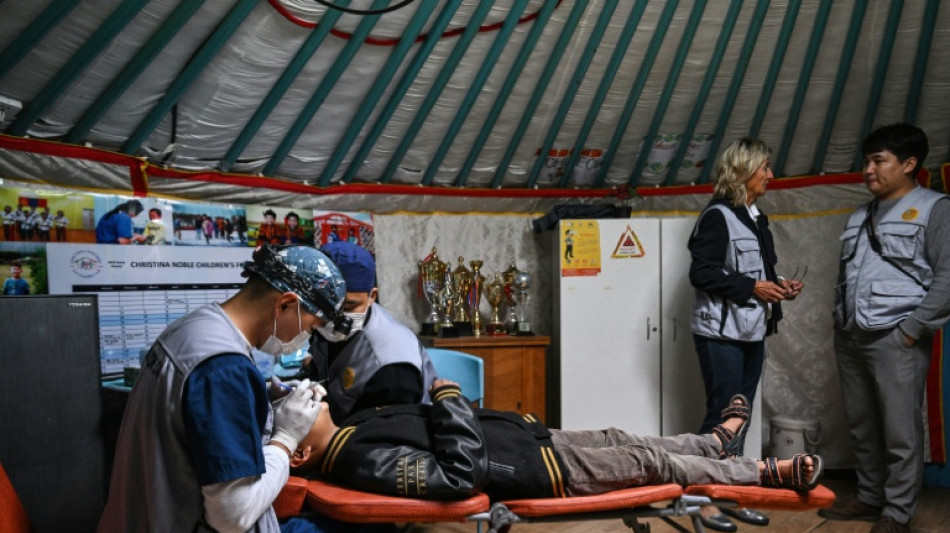
Inside a traditional Mongolian ger in the sprawling suburbs of Ulaanbaatar, children queue to have their teeth checked at a mobile dental practice that roams the vast country, providing treatment that is hard to come by in remote areas.
Hundreds of thousands of children in Mongolia suffer from untreated dental problems due to the combination of readily available sugary drinks and processed foods with a lack of dental care.
But the Misheel Kids Foundation (MKF) and its fleet of mobile dental clinics are seeking to address that, braving huge distances and frigid temperatures to provide oral healthcare to both the capital and far-flung communities.
"It was helpful that the dentists came today and actually showed us how to brush our teeth properly," Agimaa, a 14-year-old girl, told AFP during one of MKF's visits to an orphanage in the capital.
"If someone doesn't teach us, we don't necessarily know how to do it ourselves."
"It was very nice because I had a toothache," eight-year-old Altanzul told AFP after receiving care.
Around nine out of 10 children across Mongolia have tooth decay, according to the charity's pediatric dentist and project manager Namuunaa.
"We are facing a very serious situation," she told AFP at the NGO's dental facility in Ulaanbaatar.
Since the Soviet-allied communist era ended more than three decades ago, diets in the landlocked country sandwiched between Russia and China have changed dramatically.
Traditionally nomadic, the population of 3.6 million has rapidly urbanised.
Consumption of meat and dairy products, central to Mongolia's herder heritage, is now complemented by the sweet, tooth-decaying snacks and sodas found in shops across the world.
But many children, particularly in the underprivileged suburbs of Ulaanbaatar, are not taught basic oral hygiene by their parents or schools.
And although dentists are more widely accessible in the capital, Namuunaa said "demand is much higher" in rural areas.
Children there "may simply have to live with the pain," she said.
Namuunaa, who like many Mongolians goes by one name, participates in the NGO's regular "dental treks" across the country, offering free examinations and treatment in places where such health services are limited or nonexistent.
- 'Smile' -
Misheel Kids Foundation was founded by Swiss dental hygienist Gabriella Schmidt-Corsitto, who was shocked to see such high rates of childhood oral health issues in Mongolia.
"In every shop you go, it doesn't matter how far from Ulaanbaatar... you find lots of sugar," Schmidt-Corsitto told AFP.
To make matters worse, many parents are not aware of the consequences of constant sugar intake and do not teach children to regularly brush their teeth, she said.
"These two facts are, together, a disaster."
Named using the word for "smile" in Mongolian, MKF has spent more than a decade trying to cultivate better oral health habits and so far has treated more than 22,000 children, Schmidt-Corsitto said.
The NGO's newly established dental health centre is in one of Ulaanbaatar's sprawling and underprivileged suburbs known as "ger districts", named after traditional nomadic dwellings.
They offer dental services, training sessions for participants to become trainers themselves and regularly visit orphanages and daycare centres.
Alimaa, a mother of five children, spoke to AFP after a training session on oral health at the facility.
Hailing from the central-western province of Arkhangai, Alimaa said she "never went to dental clinics" in her hometown.
However, when she was a child, she said sweets were "not very common".
Now, Alimaa said instead of the soft drinks and sugary snacks that her children might find at other people's homes, she prefers serving them aaruul, a traditional dried curd snack.
- 'Dental treks' -
MKF's "dental treks" are handled by a fleet of medically equipped mobile clinics, offering services ranging from checkups and cleanings to more intensive procedures including root canal treatments and tooth extractions.
During the treks, "there are days when we see 50 to 80 children in one day", said Namuunaa, the pediatric dentist.
"It can be physically and mentally exhausting, but when you see how much the children need the treatment, you feel that you have to keep going," she said.
A majority of its funding last year came from European foundations and private donors, with other support provided locally as well as by the Mongolian government.
Securing funding is "constant hard work", she said, noting that she is also seeking more support from Mongolian authorities.
"We are not able to support the whole country, but we are an example... which could be copied," she said.
R.Fournier--PS