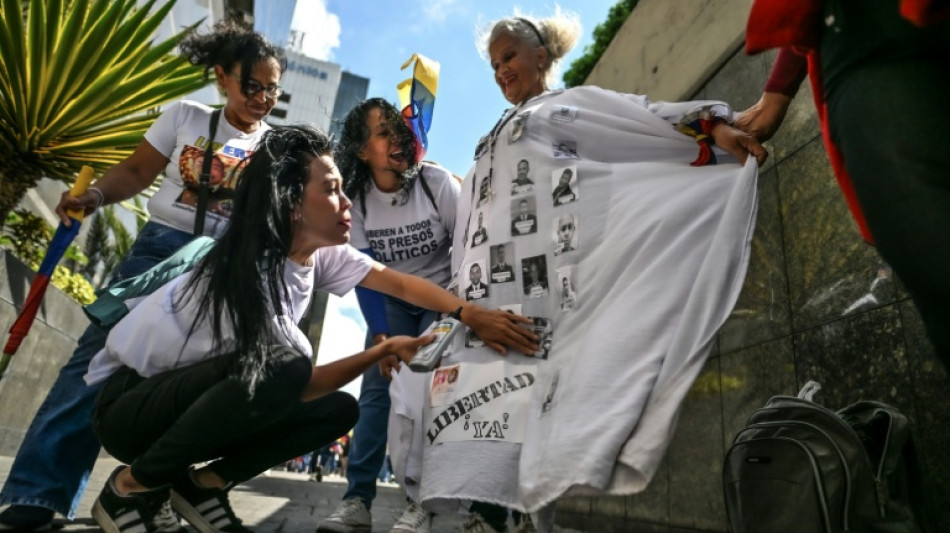
Venezuela parliament unanimously approves amnesty law / Photo: Juan BARRETO - AFP

 London
 11 °C
11 °C
 Manchester
 9 °C
9 °C
 Glasgow
 8 °C
8 °C
 Dublin
6 °C
Dublin
6 °C
 Belfast
6 °C
Belfast
6 °C
 Washington
 10 °C
10 °C
 Denver
 17 °C
17 °C
 Atlanta
14 °C
Atlanta
14 °C
 Dallas
19 °C
Dallas
19 °C
 Houston Texas
20 °C
Houston Texas
20 °C
 New Orleans
19 °C
New Orleans
19 °C
 El Paso
21 °C
El Paso
21 °C
 Phoenix
21 °C
Phoenix
21 °C
 Los Angeles
16 °C
San Diego
17 °C
San Francisco
14 °C
Chicago
13 °C
Minneapolis
15 °C
Seattle
Los Angeles
16 °C
San Diego
17 °C
San Francisco
14 °C
Chicago
13 °C
Minneapolis
15 °C
Seattle
 7 °C
Portland
9 °C
Salt Lake City
7 °C
Portland
9 °C
Salt Lake City
 11 °C
Las Vegas
15 °C
Miami
23 °C
Jacksonville
14 °C
San Antonio
18 °C
Bermuda
25 °C
Nassau
11 °C
Iqaluit
-6 °C
Yellowknife
11 °C
Las Vegas
15 °C
Miami
23 °C
Jacksonville
14 °C
San Antonio
18 °C
Bermuda
25 °C
Nassau
11 °C
Iqaluit
-6 °C
Yellowknife
 -5 °C
Anchorage
-3 °C
Fairbanks
-6 °C
Barrow
-5 °C
Anchorage
-3 °C
Fairbanks
-6 °C
Barrow
 -1 °C
Calgary
-1 °C
Calgary
 6 °C
Edmonton
6 °C
Winnipeg
14 °C
Goose Bay
6 °C
Halifax
9 °C
Boston
8 °C
Ottawa
4 °C
Toronto
7 °C
Detroit
6 °C
Edmonton
6 °C
Winnipeg
14 °C
Goose Bay
6 °C
Halifax
9 °C
Boston
8 °C
Ottawa
4 °C
Toronto
7 °C
Detroit
 11 °C
Cleveland
8 °C
New York
12 °C
Baltimore
13 °C
Philadelphia
12 °C
Nuuk (Godthåb)
-6 °C
Hong Kong
31 °C
Singapore
34 °C
Melbourne
18 °C
Canberra
21 °C
Adelaide
22 °C
Darwin
32 °C
Perth
17 °C
Fort Worth
17 °C
Honolulu
24 °C
Sydney
21 °C
Johannesburg
23 °C
Dubai
35 °C
Mumbai
36 °C
Zürich
8 °C
Tokyo
20 °C
Seoul
21 °C
Delhi
31 °C
Beijing
16 °C
Riyadh
34 °C
Prague
8 °C
Pennsylvania
8 °C
Valletta
11 °C
Cleveland
8 °C
New York
12 °C
Baltimore
13 °C
Philadelphia
12 °C
Nuuk (Godthåb)
-6 °C
Hong Kong
31 °C
Singapore
34 °C
Melbourne
18 °C
Canberra
21 °C
Adelaide
22 °C
Darwin
32 °C
Perth
17 °C
Fort Worth
17 °C
Honolulu
24 °C
Sydney
21 °C
Johannesburg
23 °C
Dubai
35 °C
Mumbai
36 °C
Zürich
8 °C
Tokyo
20 °C
Seoul
21 °C
Delhi
31 °C
Beijing
16 °C
Riyadh
34 °C
Prague
8 °C
Pennsylvania
8 °C
Valletta
 22 °C
Manama
35 °C
Warsaw
8 °C
Stockholm
10 °C
22 °C
Manama
35 °C
Warsaw
8 °C
Stockholm
10 °C
Venezuela's National Assembly on Thursday unanimously approved a long-awaited amnesty law that could free hundreds of political prisoners jailed for being government detractors.
But the law excludes those who have been prosecuted or convicted of promoting military action against the country -- which could include opposition leaders like Nobel Peace Prize winner Maria Corina Machado, who has been accused by the ruling party of calling for international intervention like the one that ousted former president Nicolas Maduro.
The bill was then signed by interim president Delcy Rodriguez, who pushed for the legislation under pressure from Washington, after she rose to power following Maduro's capture during a US military raid on January 3.
"One must know how to ask for forgiveness and one must also know how to receive forgiveness," Rodriguez said at the Miraflores presidential palace in the capital Caracas, after signing the bill into law.
The law is meant to apply retroactively to 1999 -- including the coup against previous leader Hugo Chavez, the 2002 oil strike, and the 2024 riots against Maduro's disputed reelection -- giving hope to families that loved ones will finally come home.
Some fear, however, the law could be used by the government to pardon its own and selectively deny freedom to real prisoners of conscience.
Article 9 of the bill lists those excluded from amnesty as "persons who are being prosecuted or may be convicted for promoting, instigating, soliciting, invoking, favoring, facilitating, financing or participating in armed actions or the use of force against the people, sovereignty, and territorial integrity" of Venezuela "by foreign states, corporations or individuals."
Venezuela's National Assembly had delayed several sittings meant to pass the amnesty bill.
"The scope of the law must be restricted to victims of human rights violations and expressly exclude those accused of serious human rights violations and crimes against humanity, including state, paramilitary and non-state actors," UN human rights experts said in a statement from Geneva Thursday.
- Genuine will? -
Hundreds, perhaps thousands, of Venezuelans have been jailed in recent years over plots, real or imagined, to overthrow the government of Rodriguez's predecessor and former boss Maduro, who was in the end toppled in the deadly US military raid.
Family members have reported torture, mistreatment and neglected health problems among the inmates.
The NGO Foro Penal says about 450 prisoners have been released since Maduro's ouster, but more than 600 others remain behind bars.
Family members have been clamoring for their release for weeks, holding vigils outside prisons.
One small group, in the capital Caracas, staged a nearly weeklong hunger strike which ended Thursday.
"The National Assembly has the opportunity to show whether there truly is a genuine will for national reconciliation," Foro Penal director Gonzalo Himiob wrote on X Thursday ahead of the vote.
On Wednesday, the chief of the US military command responsible for strikes on alleged drug smuggling boats off South America held talks in Caracas with Rodriguez and top ministers Vladimir Padrino (defense) and Diosdado Cabello (interior).
All three were staunch Maduro backers who for years echoed his "anti-imperialist" rhetoric.
Rodriguez's interim government has been governing with US President Donald Trump's consent, provided she grants access to Venezuela's vast oil resources.
S.Morel--PS