Ukraine hopes renewables can Russia-proof power grid / Photo: Marian PAVLYK - AFP

 London
 14 °C
14 °C

 Manchester
 15 °C
15 °C
 Glasgow
9 °C
Glasgow
9 °C
 Dublin
16 °C
Dublin
16 °C
 Belfast
16 °C
Belfast
16 °C
 Washington
 15 °C
15 °C
 Denver
21 °C
Denver
21 °C
 Atlanta
21 °C
Atlanta
21 °C
 Dallas
24 °C
Dallas
24 °C
 Houston Texas
26 °C
Houston Texas
26 °C
 New Orleans
26 °C
New Orleans
26 °C
 El Paso
23 °C
El Paso
23 °C
 Phoenix
32 °C
Phoenix
32 °C
 Los Angeles
25 °C
San Diego
24 °C
San Francisco
16 °C
Chicago
16 °C
Minneapolis
12 °C
Seattle
Los Angeles
25 °C
San Diego
24 °C
San Francisco
16 °C
Chicago
16 °C
Minneapolis
12 °C
Seattle
 15 °C
Portland
20 °C
Salt Lake City
19 °C
Las Vegas
30 °C
Miami
28 °C
Jacksonville
24 °C
San Antonio
26 °C
Bermuda
26 °C
Nassau
16 °C
Iqaluit
0 °C
Yellowknife
4 °C
Anchorage
7 °C
Fairbanks
0 °C
Barrow
-8 °C
Calgary
9 °C
Edmonton
15 °C
Winnipeg
9 °C
Goose Bay
15 °C
Portland
20 °C
Salt Lake City
19 °C
Las Vegas
30 °C
Miami
28 °C
Jacksonville
24 °C
San Antonio
26 °C
Bermuda
26 °C
Nassau
16 °C
Iqaluit
0 °C
Yellowknife
4 °C
Anchorage
7 °C
Fairbanks
0 °C
Barrow
-8 °C
Calgary
9 °C
Edmonton
15 °C
Winnipeg
9 °C
Goose Bay
 11 °C
Halifax
9 °C
Boston
14 °C
Ottawa
9 °C
Toronto
11 °C
Detroit
14 °C
Cleveland
12 °C
New York
17 °C
Baltimore
14 °C
Philadelphia
15 °C
Nuuk (Godthåb)
0 °C
Hong Kong
28 °C
Singapore
31 °C
Melbourne
25 °C
Canberra
11 °C
Halifax
9 °C
Boston
14 °C
Ottawa
9 °C
Toronto
11 °C
Detroit
14 °C
Cleveland
12 °C
New York
17 °C
Baltimore
14 °C
Philadelphia
15 °C
Nuuk (Godthåb)
0 °C
Hong Kong
28 °C
Singapore
31 °C
Melbourne
25 °C
Canberra
 22 °C
Adelaide
22 °C
Adelaide
 19 °C
Darwin
31 °C
Perth
18 °C
Fort Worth
24 °C
Honolulu
27 °C
Sydney
23 °C
Johannesburg
14 °C
Dubai
31 °C
Mumbai
32 °C
Zürich
10 °C
Tokyo
19 °C
Darwin
31 °C
Perth
18 °C
Fort Worth
24 °C
Honolulu
27 °C
Sydney
23 °C
Johannesburg
14 °C
Dubai
31 °C
Mumbai
32 °C
Zürich
10 °C
Tokyo
 24 °C
Seoul
23 °C
Delhi
29 °C
Beijing
22 °C
Riyadh
27 °C
Prague
7 °C
Pennsylvania
11 °C
Valletta
25 °C
Manama
32 °C
Warsaw
9 °C
Stockholm
11 °C
24 °C
Seoul
23 °C
Delhi
29 °C
Beijing
22 °C
Riyadh
27 °C
Prague
7 °C
Pennsylvania
11 °C
Valletta
25 °C
Manama
32 °C
Warsaw
9 °C
Stockholm
11 °C
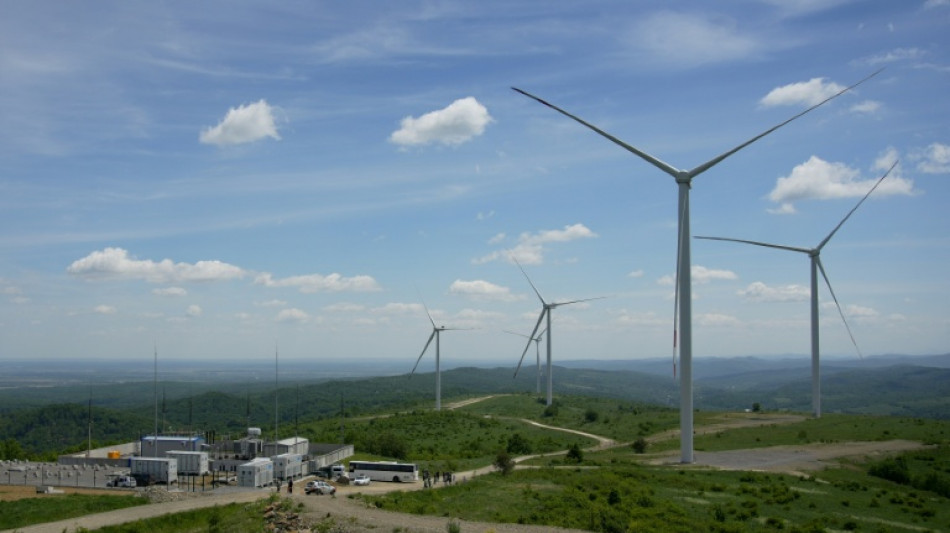
Quick to build and able to power a small city, the Oriv wind farm in western Ukraine is exactly the kind of project Kyiv hopes will backstop its power grid against routine Russian strikes.
Waves of Russian drones and missiles have ravaged Ukrainian energy infrastructure since 2022, cutting power to millions of people in what Kyiv and the International Criminal Court classify as a war crime aimed at demoralising its people.
Faced with the relentless attacks, Ukraine has set itself ambitious targets to shift away from Soviet-era coal and gas plants towards decentralised, renewable energy sources like wind and solar.
Diversifying should be "the cornerstone of Ukraine's energy resilience," the energy ministry wrote in a report last year.
While other countries are shifting towards renewables because they emit fewer greenhouse gases, in Ukraine, the technologies offer the added advantage of being harder to destroy -- as they are spread across a larger area -- and cheaper to replace.
"It is an incredible support for the energy system in difficult times," Greenpeace coordinator Marine Abramyan told AFP from the Oriv wind farm, in Ukraine's western Lviv region.
Its 10 turbines cover the annual consumption of about 125,000 people -- the size of a small city, according to the Czech investors who helped fund it.
It was built in about three years, despite delays caused by the war, opening in September 2024.
"The fact that it was built so quickly shows how well renewable energy can meet the energy needs that we Ukrainians have right now," Abramyan added.
Russia's attacks on Ukrainian energy infrastructure last winter were among the worst of the more than four-year war, as strikes knocked out multiple thermal plants near Kyiv during -20C temperatures.
Russia has launched at least 6,194 attacks on Ukrainian energy facilities since it invaded in February 2022, the country's energy ministry told AFP.
- Wartime construction -
Ukraine aims to have 27 percent of all electricity production from renewables by 2030 -- up from 11 percent at the moment -- according to a plan adopted in 2024.
But progress has, so far, been slow.
Russian attacks and occupation of the south and east destroyed 90 percent of Ukraine's installed wind capacity -- 1.7 gigawatts across 34 wind farms at the end of 2021.
Ukraine has so far built back some 700 megawatts, its national wind energy association told AFP.
Ukrainian companies, particularly smaller business and local authorities, have started investing in solar energy to provide energy during outages.
The Oriv wind farm, co-financed by Ukrainian group Eco-Optima and Czech group MND, was commissioned before the war.
Constructing it in the midst of the invasion proved difficult, in part because suppliers and haulers were unwilling to take the insurance risk.
"First of all, there were difficulties with transporting the wind turbine components," said Yuriy Fedak, a director at Eco-Optima.
"It was impossible to deliver them to the site, because the foreign companies with which contracts had been signed cited force majeure and were unwilling to send their vehicles and personnel here to Ukraine, where the war was ongoing."
The company eventually turned to a Ukrainian hauler, which loaded the parts at the Polish border and brought them to the site.
- Investment needed -
Fitting the wind turbines into the grid is also a challenge.
Since the war began, Ukraine has heavily leaned on its three active nuclear plants to provide its base load of energy -- the minimum level of power needed to meet demand over a given period, with its largest nuclear plant under Russian occupation.
The coal and gas-fired plants designed to cover peak loads -- when demand is greater -- have suffered heavy damage in Russian strikes, heaping pressure on weather-dependent renewables.
For renewables to be able to cover peak consumption, there needs to be "significant investment in energy storage systems," Glib Vyshlinsky, director of Kyiv's Centre for Economic Strategy, told AFP.
Eco-Optima is planning eventually to add a battery system of around 60 Megawatts, to store electricity and feed it back to the grid later, depending on needs.
Even with the challenges, wind power has a key advantage: resilience from Russian attacks, said Andriy Konechenkov, president of the Ukrainian Wind Energy Association.
"If one wind turbine is struck by a drone, the others keep running."
strs-cad/jc/yad
R.Fournier--PS