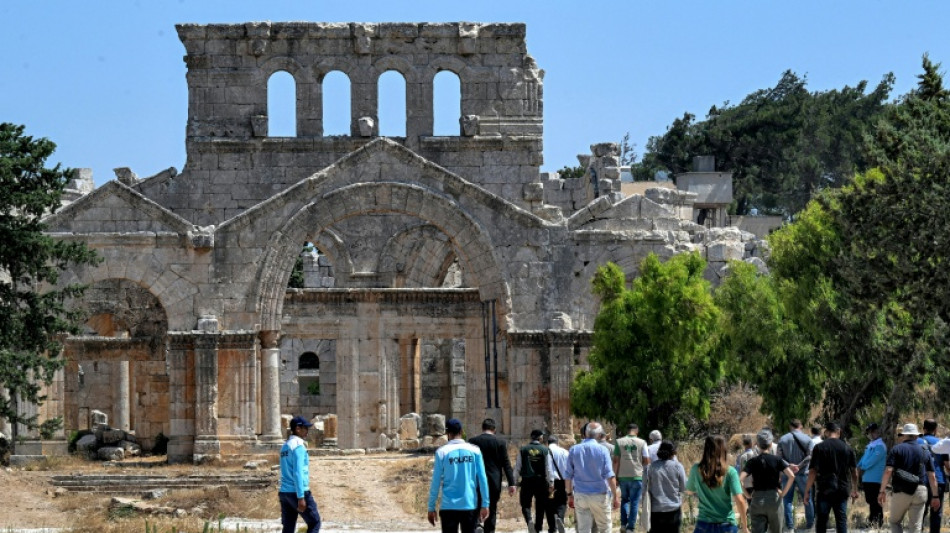
Scars of war linger on Syria's Saint Simeon monastery / Photo: LOUAI BESHARA - AFP

 London
 16 °C
16 °C

 Manchester
 15 °C
15 °C
 Glasgow
10 °C
Glasgow
10 °C
 Dublin
 11 °C
11 °C
 Belfast
11 °C
Belfast
11 °C
 Washington
 12 °C
12 °C
 Denver
8 °C
Denver
8 °C
 Atlanta
13 °C
Atlanta
13 °C
 Dallas
21 °C
Dallas
21 °C
 Houston Texas
21 °C
Houston Texas
21 °C
 New Orleans
20 °C
New Orleans
20 °C
 El Paso
19 °C
El Paso
19 °C
 Phoenix
23 °C
Phoenix
23 °C
 Los Angeles
19 °C
San Diego
20 °C
San Francisco
14 °C
Chicago
14 °C
Minneapolis
Los Angeles
19 °C
San Diego
20 °C
San Francisco
14 °C
Chicago
14 °C
Minneapolis
 6 °C
Seattle
11 °C
Portland
12 °C
Salt Lake City
14 °C
Las Vegas
19 °C
Miami
25 °C
Jacksonville
20 °C
San Antonio
23 °C
Bermuda
23 °C
Nassau
15 °C
Iqaluit
-7 °C
Yellowknife
-6 °C
Anchorage
5 °C
Fairbanks
6 °C
Seattle
11 °C
Portland
12 °C
Salt Lake City
14 °C
Las Vegas
19 °C
Miami
25 °C
Jacksonville
20 °C
San Antonio
23 °C
Bermuda
23 °C
Nassau
15 °C
Iqaluit
-7 °C
Yellowknife
-6 °C
Anchorage
5 °C
Fairbanks
 1 °C
Barrow
-2 °C
Calgary
1 °C
Edmonton
11 °C
Winnipeg
0 °C
Goose Bay
6 °C
Halifax
13 °C
Boston
14 °C
Ottawa
4 °C
Toronto
8 °C
Detroit
11 °C
Cleveland
12 °C
New York
17 °C
Baltimore
13 °C
Philadelphia
14 °C
Nuuk (Godthåb)
-2 °C
Hong Kong
1 °C
Barrow
-2 °C
Calgary
1 °C
Edmonton
11 °C
Winnipeg
0 °C
Goose Bay
6 °C
Halifax
13 °C
Boston
14 °C
Ottawa
4 °C
Toronto
8 °C
Detroit
11 °C
Cleveland
12 °C
New York
17 °C
Baltimore
13 °C
Philadelphia
14 °C
Nuuk (Godthåb)
-2 °C
Hong Kong
 30 °C
Singapore
30 °C
Singapore
 32 °C
Melbourne
25 °C
Canberra
32 °C
Melbourne
25 °C
Canberra
 18 °C
Adelaide
19 °C
Darwin
33 °C
Perth
18 °C
Adelaide
19 °C
Darwin
33 °C
Perth
 26 °C
Fort Worth
20 °C
Honolulu
25 °C
Sydney
22 °C
Johannesburg
20 °C
Dubai
28 °C
Mumbai
31 °C
Zürich
8 °C
Tokyo
21 °C
Seoul
16 °C
Delhi
20 °C
Beijing
13 °C
Riyadh
25 °C
Prague
4 °C
Pennsylvania
13 °C
Valletta
20 °C
Manama
30 °C
Warsaw
4 °C
Stockholm
8 °C
26 °C
Fort Worth
20 °C
Honolulu
25 °C
Sydney
22 °C
Johannesburg
20 °C
Dubai
28 °C
Mumbai
31 °C
Zürich
8 °C
Tokyo
21 °C
Seoul
16 °C
Delhi
20 °C
Beijing
13 °C
Riyadh
25 °C
Prague
4 °C
Pennsylvania
13 °C
Valletta
20 °C
Manama
30 °C
Warsaw
4 °C
Stockholm
8 °C
Near the base of a column atop which Saint Simeon Stylites once perched, scattered stones lay bare the damage inflicted on the surrounding Byzantine monastery in northern Syria by war, looting and rampant illegal excavations.
AFP accompanied a French archaeological delegation to inspect the site after more than a decade of conflict and assess what could be restored.
The fifth-century monastery and its church are, alongside hundreds of abandoned ancient villages in northern Syria known as the "dead" or "forgotten cities", a UNESCO World Heritage Site.
Holding her camera and notebook, archaeologist Micheline Kurdi walked through the ruins to document the site's state and plan the first "quick interventions" to restore it, she told AFP.
"There is irreparable damage in the monastery in the southeastern section, but on the other hand the church is standing firm and in good condition," the 42-year-old French-Syrian said.
Inside the monastery, AFP journalists saw cracked arches and partially collapsed stone walls, while the monks' living quarters remained intact.
- 'Rebuild it' -
Syria was once an archaeologist's paradise, home to some of the oldest and best-preserved jewels of ancient civilisations.
Following the start of the civil war in 2011, archaeological sites across the country were damaged, museums looted and historic city centres levelled.
One of the most famous cases was Palmyra, the Roman-era city in Syria's desert with an imposing kilometre-long colonnade, where the Islamic State jihadist group launched a campaign of destruction and looting after capturing the site in 2015.
The Saint Simeon monastery itself was subjected to "looting, illegal excavation, military use and neglect", according to site director Abdel Jalil Arabi.
It was controlled by various armed groups throughout the war, he said.
An airstrike hit the monastery in 2016, which UNESCO condemned without naming the party responsible, while it was further damaged by a major earthquake in 2023.
Arabi estimated that 30 to 40 percent of the site has been damaged, pointing to the collapse of the western arch and its columns.
As for Saint Simeon's column, Arabi said "the base is there, but the remains of the column are scattered, and we will try to rebuild it".
The monastery, which includes one of the oldest major churches in Christianity, was built around a column that Saint Simeon sat on for years, dedicating his life to prayer.
Kurdi, who dedicated her doctoral thesis to the monastery complex, said they needed to "review old plans" to reinstall the base of the main column "and the part that remained of it".
- Past and future -
Jean-Baptiste Faivre, French charge d'affaires in Syria, said "this heritage is extremely important, not only for Syria's past but also for its future".
"There will be cooperation between the Syrian Directorate-General of Antiquities and Museums and French cultural institutions to help restore and develop this site."
Vincent Gelot from the French Catholic organisation Oeuvre d'Orient, who was also at the site, said the restoration would be carried out "with the support of donors and our partners, such as the French Embassy and the Aliph Foundation, which works to protect heritage in war-affected countries".
"We hope that tourists and pilgrims will one day return to this place, because it still carries a message and speaks to us even today," he added.
W.Bonnet--PS